Vol. XI · No. 7 — The Annotated Issue Printed quarterly, on paper, on purpose Twelve dollars · Worth it

The Margi­nalia

A quarterly for people who write in books

Autumn MMXXVI Founded in a second-hand bookshop, 2014 In this issue: margins, staircases, apologies Est. reading time: one long bath

The Lead Feature · Page One

In defense of the margin

The most honest writing of the last five centuries never made it past the edge of the page. A brief history of readers who talked back — and why the blank inch beside the text may be literature's last free country.

Somewhere in a university library there is a 1652 edition of Montaigne in which an anonymous reader has written, beside a passage on friendship, a single devastating word: “liar.” Nobody knows who held the pen. We know only that the ink has outlived the argument, the reader, and very nearly the paper itself.

This magazine exists because of that word. Not the accusation — the impulse. The refusal to read silently. Print taught us to receive text as a finished verdict; the margin was the space the verdict forgot to seal. In it, readers have corrected popes, proposed marriage, done arithmetic, and confessed to crimes both literary and actual.

The screen, for all its infinite room, gives us nowhere to stand beside a sentence. So we went back to paper — and we brought a pen.

Continued on page fourteen

Page Fourteen · The Essay

A short history of talking back

Continued from page one. — The word itself is a late arrival. Marginalia enters English in 1819, coined in print by Samuel Taylor Coleridge,1 a man whose friends eventually stopped lending him books for the same reason you stop lending anything to a fire. Coleridge did not annotate; he colonized. His notes ran up gutters, swallowed flyleaves, and were — this is the scandal — frequently better than the text they surrounded.

But the practice is far older than its name. Medieval scribes left complaints in the margins of the manuscripts they copied: about the cold, about the quality of the vellum, about a cat that walked through wet ink one night in Deventer2 and was cursed, in careful Gothic script, for all eternity. The margin has always been where the body of the reader leaks into the body of the text.

“A book unmarked is a conversation you attended but refused to join.”

Consider what the margin actually is: a typographic mercy. Early printers ruled the page the way surveyors rule land, and the white border they left was structural — room for thumbs, for trimming, for rot.3 Readers annexed it almost immediately. By the sixteenth century, students were taught annotation as a discipline, with its own symbols: the pointing hand, the flower, the small skeptical trefoil that meant prove it.

Then the margin democratized. Darwin scribbled “whew” in Lamarck. Twain filled other men's memoirs with insults so precise they read as craftsmanship.4 An unknown Victorian governess worked out, in the endpapers of a household almanac, what is essentially a theory of compound interest — and beneath it, a grocery list. The margin does not rank its contents. That is its entire politics.

What we lose without it is not note-taking; apps take notes superbly. We lose location. A marginal note is testimony given at the scene — this sentence, this inch of paper, this pencil going soft. Digital highlights float in a database; marginalia is buried where it fell.5 Future readers do not retrieve it. They stumble on it, the way you stumble on a stranger's umbrella in a pew, and know suddenly that you were never the first person here.

So: buy the pencil. Deface the book. Somewhere downstream a reader you will never meet is waiting to find out that the argument on page fourteen made somebody, once, write liar — and feel less alone for it.
Pages Twenty-Two & Twenty-Three · The Plates

Concrete, paper, light

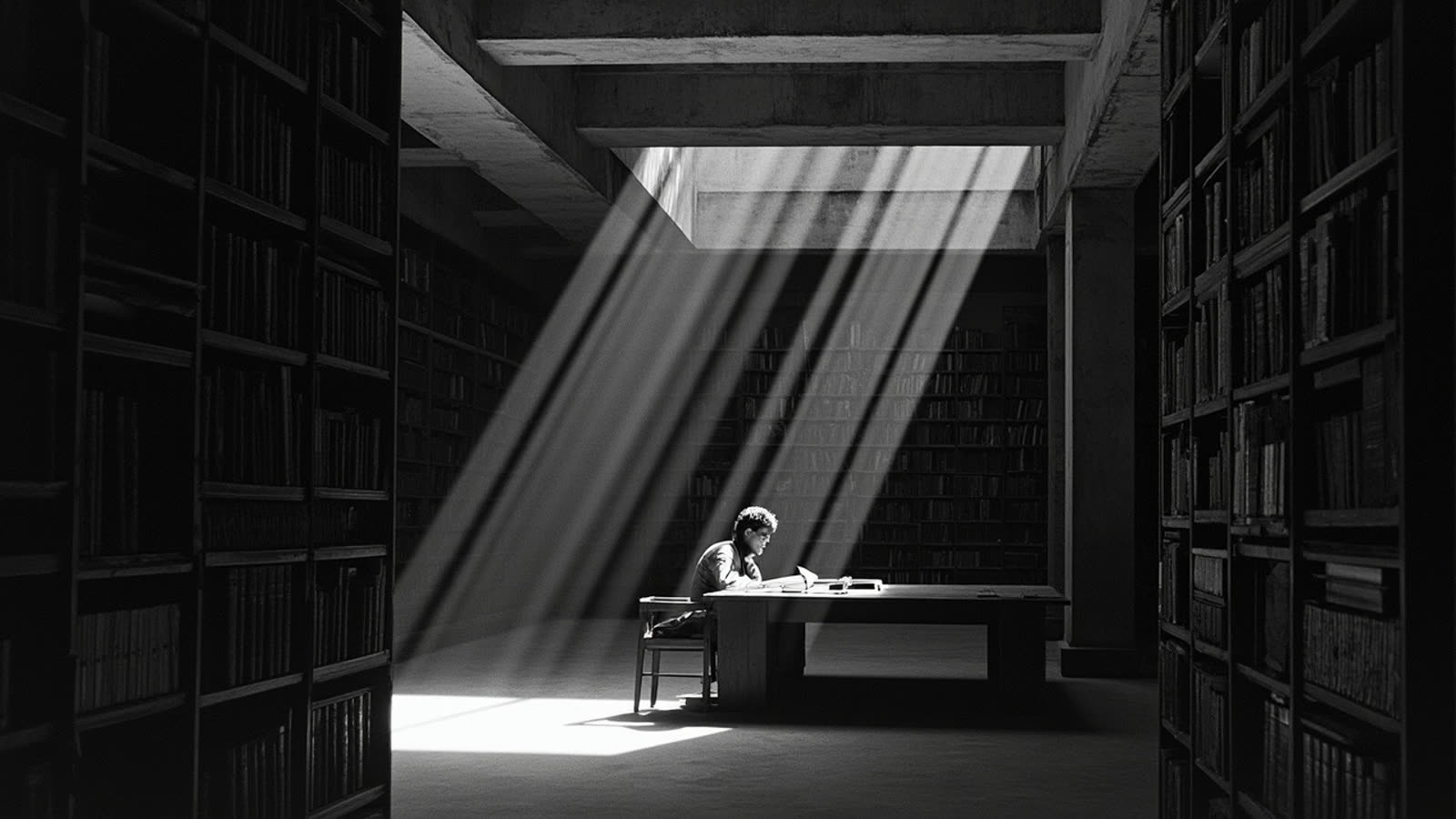
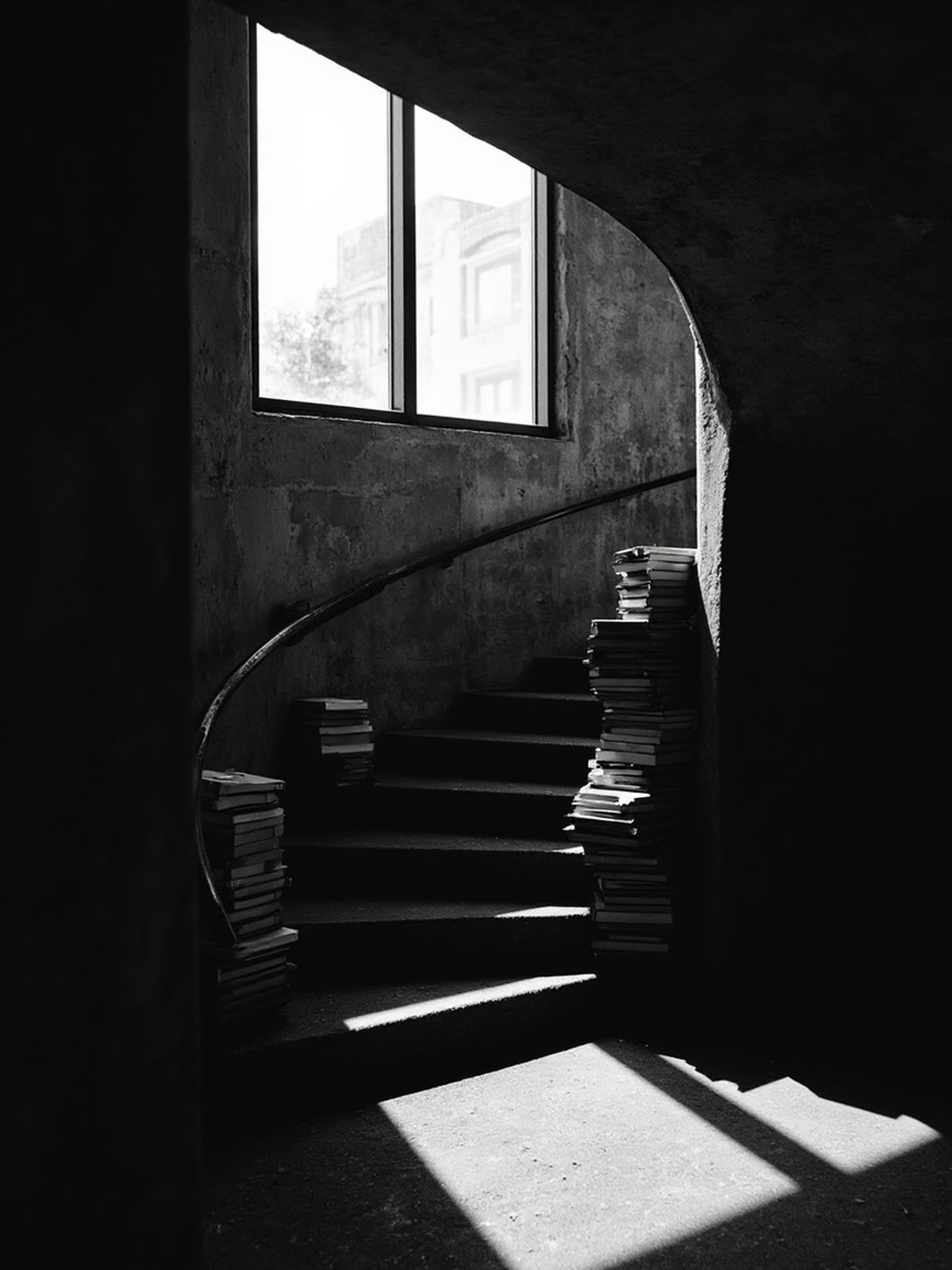
We photograph libraries the way others photograph cathedrals, and for the same reason: both were built to make a private act feel enormous.

Black and white photograph of a vast brutalist library hall, a single reader at a long table beneath diagonal shafts of light
I.The reading room, 11:04 a.m. — The architects allowed one window. The window, in return, allows everything. 35mm, pushed.
Black and white photograph of a brutalist spiral staircase with stacks of books resting on the concrete steps
II.The north stair. — Overflow stock ascends toward cataloguing at roughly one shelf per decade.

Page Thirty-One · Letters to the Editor

The readers respond

On the ethics of pencils

Your spring issue argued that annotating a borrowed book is theft. Nonsense. It is interest, paid in ink. I return every book improved, and only one friendship has been lost this way, which I consider an acceptable print run.

M. Okonkwo · Aberdeen

A correction, reluctantly

You claim Coleridge never returned a borrowed book. False: he returned Charles Lamb's Milton in 1816, annotated to the point of being, by weight, mostly Coleridge. Lamb called it an upgrade. Pedantry is love with footnotes; print the correction.

Prof. H. Vandermeer · Utrecht

Found in a margin

In a charity-shop copy of your first issue I found, beside your editorial, a note in blue biro: “overwritten, but he means it.” I am framing the page. Whoever you are — write to us. You clearly belong here.

The Editors · on behalf of blue biro

Disagree with something on this page? Good. Write in the margin →